Hey there 👋
Online GCSE & A-level tutoring to help you ace it.
1-1 online Maths, Biology and Chemistry tutoring for GCSE and A-level, plus UCAT preparation, with Umer, a medical student with 3 A*s at A-level, ten 9s at GCSE and a UCAT score of 2370 (Band 1), helping boost your confidence and giving you the best chance to secure top grades.
 Meet UmerYour tutor · Enhanced DBS checked
Boost your grades
Every session is built around you. We spend the hour on whatever you’re finding tricky, so you’re never wasting time on stuff you already know.
Study smarter, not harder
I’ll show you how to really understand a topic instead of just memorising it, so it still makes sense when you’re sitting the exam.
Ask me anything
If something doesn’t make sense, just tell me. No question is too small, and we’ll go through it together until it does.
Kind words
What parents and students say about their sessions.
My son has found his tutoring sessions with Umer really helpful in preparing for his GCSE Maths resit. Umer explained things really clearly and really helped my son improve in areas that he was less confident about. Umer was always reliable and punctual, I would definitely recommend him.
Had a session with me? I’d love to hear how it went. Leave a review
Simple pricing
£30 for one hour of 1-1 tutoring, with no contracts and pay-as-you-go terms.
Pick a timeQuestions, answered
What subjects and levels do you teach?
GCSE and A-level Maths, Biology and Chemistry, plus UCAT preparation. I scored 2370 (Band 1) in the UCAT myself.
How much does a session cost?
Each one-hour, one-to-one session costs £30.
How do the lessons work?
Lessons are held online on Zoom, and your booking confirmation is emailed to you after you book and pay.
Are you DBS checked?
Yes, I hold an Enhanced DBS check, so parents and students can book with confidence. If you’d like to know more, just email me.
Which exam boards do you cover?
I teach AQA for Biology and Chemistry and Edexcel for Maths, at both GCSE and A-level. I don’t cover other exam boards, so please check yours before booking. My Chemistry revision PDF is written for AQA A-level.
What happens in the first lesson?
We start by finding out where you’re stuck, then work through those topics together at your pace.
How do I book, and can a parent ask questions first?
Choose a session in the Book section and pay securely when you book. Parents are welcome to email acediteducationsupport@gmail.com with any questions before paying.
What’s in the AQA Chemistry PDF, and how do I get it?
It’s a 6-page revision PDF covering every inorganic reaction for AQA A-level Chemistry: Group 2, Group 7, Period 3 elements and their oxides, transition metals, and reactions of ions in aqueous solution. It costs £3, and you can download it straight away on the thank-you page you’re taken to after paying.
Book a session
1-1 tutoring · 1 hour · £30. Choose your session type, pick a time that suits you and pay securely when you book.
Enhanced DBS checked. All sessions are with me, Umer.
Available: Saturdays & Sundays 9am–3pm · Mondays, Tuesdays & Thursdays 6–8pm
GCSE / A-level tutoring
Maths, Biology and Chemistry. One hour, one-to-one, online.
Exam boards: AQA Biology & Chemistry · Edexcel Maths
UCAT tutoring
One-to-one help preparing for the UCAT, from someone who scored 2370 and Band 1. One hour, online.
Choose a time and pay securely. Your confirmation is emailed to you.
Cancellations & refunds
- 24 hours’ notice or more: cancel or reschedule for free, and I’ll refund your session in full.
- Less than 24 hours’ notice, or a missed session: these aren’t refundable, but get in touch and I’ll try to rearrange where I can.
- If I need to cancel: you’ll get a full refund or a new time, whichever you prefer.
- The Inorganic Reactions PDF: it’s a digital product, so it can’t be returned once it’s been sent. If there’s a problem with the file, email me and I’ll put it right.
To cancel or reschedule, use the link in your booking confirmation email, or email acediteducationsupport@gmail.com. This doesn’t affect your legal rights.
A-level topics, simplified
Every topic from the specification in plain English, so you can see what we’ll cover and where you’re stuck. Biology and Chemistry follow AQA, and Maths follows Edexcel. Pick a subject, or search for a topic.
A-level Biology (7402)
Eight topics, covered across the two years. The first four also make up the AS course.
Biological molecules
Carbohydrates, lipids, proteins, DNA, ATP, water and enzymes.
Cells
Cell structure, membranes and transport, cell division and the immune system.
Organisms exchange substances with their environment
Surface area to volume, gas exchange, digestion and mass transport in animals and plants.
Genetic information, variation and relationships between organisms
DNA, meiosis, genetic diversity, biodiversity and classification.
Energy transfers in and between organisms
Photosynthesis, respiration, energy flow in ecosystems and nutrient cycles.
A-level onlyOrganisms respond to changes in their internal and external environments
Stimuli, nervous coordination, muscle contraction and homeostasis.
A-level onlyGenetics, populations, evolution and ecosystems
Inheritance, Hardy-Weinberg, evolution, speciation and population change.
A-level onlyThe control of gene expression
Mutations, how genes are switched on and off, and gene technologies.
A-level onlyRecommended resources
These are resources I personally used for my A-Level revision and greatly helped me achieve top grades.

A-level Chemistry (7405)
Physical, inorganic and organic chemistry. Topics marked “A-level only” are not part of the AS course.
Atomic structure
Isotopes, mass spectrometry, electron configuration and ionisation energy.
Amount of substance
The mole, concentrations, gas volumes, yields and atom economy.
Bonding
Ionic, covalent and metallic bonding, shapes of molecules and intermolecular forces.
Energetics
Enthalpy changes, calorimetry, Hess’s law and bond enthalpies.
Kinetics
Collision theory, activation energy, catalysts and Maxwell-Boltzmann curves.
Chemical equilibria, Le Chatelier’s principle and Kc
How equilibria shift, and the equilibrium constant Kc.
Oxidation, reduction and redox equations
Oxidation states and balancing half-equations.
Thermodynamics
Born-Haber cycles, lattice enthalpy, entropy and free energy.
A-level onlyRate equations
Orders of reaction, rate constants and the rate-determining step.
A-level onlyEquilibrium constant Kp for homogeneous systems
Gas equilibria and partial pressures.
A-level onlyElectrode potentials and electrochemical cells
Cell diagrams, standard electrode potentials and fuel cells.
A-level onlyAcids and bases
pH, Ka, buffers and titration curves.
A-level onlyPeriodicity
Trends across Period 3, including ionisation energy and melting points.
Group 2, the alkaline earth metals
Trends in reactions and compounds of Group 2.
Group 7(17), the halogens
Displacement reactions, halides and uses of chlorine.
Properties of Period 3 elements and their oxides
Reactions with oxygen and water, and the structure and pH of the oxides.
A-level onlyTransition metals
Complex ions, colour, variable oxidation states and catalysts.
A-level onlyReactions of ions in aqueous solution
Metal-aqua ions, precipitation and ligand substitution.
A-level onlyIntroduction to organic chemistry
Naming compounds, isomerism and the basics of mechanisms.
Alkanes
Fuels, cracking, combustion and radical substitution.
Halogenoalkanes
Nucleophilic substitution and elimination.
Alkenes
Electrophilic addition and addition polymers.
Alcohols
Making alcohols, oxidation and dehydration.
Organic analysis
Test-tube tests and infrared spectroscopy.
Optical isomerism
Chiral molecules and enantiomers.
A-level onlyAldehydes and ketones
Carbonyl reactions and nucleophilic addition.
A-level onlyCarboxylic acids and derivatives
Esters, acyl chlorides and acid anhydrides.
A-level onlyAromatic chemistry
The structure of benzene and electrophilic substitution.
A-level onlyAmines
Making amines and their reactions.
A-level onlyPolymers
Addition and condensation polymers, including polyesters and polyamides.
A-level onlyAmino acids, proteins and DNA
Amino acid and protein structure, DNA and enzyme action.
A-level onlyOrganic synthesis
Planning multi-step routes between compounds.
A-level onlyNuclear magnetic resonance spectroscopy
Reading proton and carbon-13 NMR spectra.
A-level onlyChromatography
Thin-layer, gas and high-performance liquid chromatography.
A-level onlyRecommended resources
These are resources I personally used for my A-Level revision and greatly helped me achieve top grades.


A-level Mathematics (9MA0)
Pure mathematics, statistics and mechanics, numbered as in the Pearson Edexcel specification.
Proof
Proof by deduction, exhaustion, counter-example and contradiction.
Algebra and functions
Indices, surds, quadratics, inequalities, functions, transformations and partial fractions.
Coordinate geometry in the (x, y) plane
Straight lines, circles and parametric equations.
Sequences and series
The binomial expansion, arithmetic and geometric series.
Trigonometry
Radians, identities, equations and small-angle approximations.
Exponentials and logarithms
Growth and decay, log laws and modelling.
Differentiation
Gradients, rates of change and the chain, product and quotient rules.
Integration
Areas under curves, by parts, substitution and differential equations.
Numerical methods
Solving equations by iteration and the trapezium rule.
Vectors
Vectors in two and three dimensions.
Statistical sampling
Populations, samples and sampling methods.
Data presentation and interpretation
Histograms, box plots, correlation and regression.
Probability
Venn diagrams, tree diagrams and conditional probability.
Statistical distributions
The binomial and normal distributions.
Statistical hypothesis testing
Testing claims using binomial, normal and correlation tests.
Quantities and units in mechanics
Modelling assumptions and working with units.
Kinematics
Motion graphs, SUVAT and variable acceleration.
Forces and Newton’s laws
Resolving forces, friction and connected particles.
Moments
Turning effects, rods, beams and equilibrium.
Recommended resources
These are resources I personally used for my A-Level revision and greatly helped me achieve top grades.


No topics match your search.
The UCAT, and how I did
I scored 2370 and Band 1 in the UCAT, which puts me above the 90th percentile of candidates in the 2025 cycle. I know what the test feels like from the inside, and that’s exactly what I bring to my UCAT tutoring.
About the UCAT
The UCAT is the admissions test used by most UK medical and dental schools. It’s a computer-based test of just under two hours, split into four timed sections. Every question is multiple choice and there’s no negative marking.
Verbal Reasoning
Read short passages, then judge what you can and can’t conclude from them.
44 questions22 minDecision Making
Apply logic, weigh up arguments and work through statistics to reach the right decision.
35 questions37 minQuantitative Reasoning
Solve numerical problems quickly, mostly using charts, tables and graphs.
36 questions26 minSituational Judgement
Decide how someone should behave in realistic scenarios, like the ones you’ll meet as a doctor.
69 questions26 minYour total score
The first three sections are each scored from 300 to 900 and added together, giving a total from 900 to 2700.
Situational Judgement band
This section is scored separately in four bands. Band 1 is the highest and Band 4 is the lowest.
Where 2370 sits
The 2025 cycle’s results, as a graph. Move your mouse (or drag your finger) across the chart to see what any score is worth, and use the tabs to look at each section.
Percentiles between the published deciles are estimated, so treat them as approximate. Candidates in 2025: 41,354. Abstract Reasoning was removed from the test in 2025, so these scores can’t be compared directly with earlier years. Source: UCAT Consortium, Test Statistics 2025 (data to 26 September 2025).
Situational Judgement bands, 2025
How candidates were spread across the four bands. Band 1 is where I landed, alongside about one in five candidates.
Want help with the UCAT?
One-to-one UCAT tutoring, one hour at a time, from someone who has sat it and scored well.
Book UCAT tutoringWatch my videos
Paper walkthroughs and worked solutions from my YouTube channel, newest first. Press play to watch without leaving the site.
Latest video
Browse by subject
Study resources
Revision materials, plus a reading list for anyone aiming at medicine.
AQA A-Level Chemistry: All Inorganic Reactions
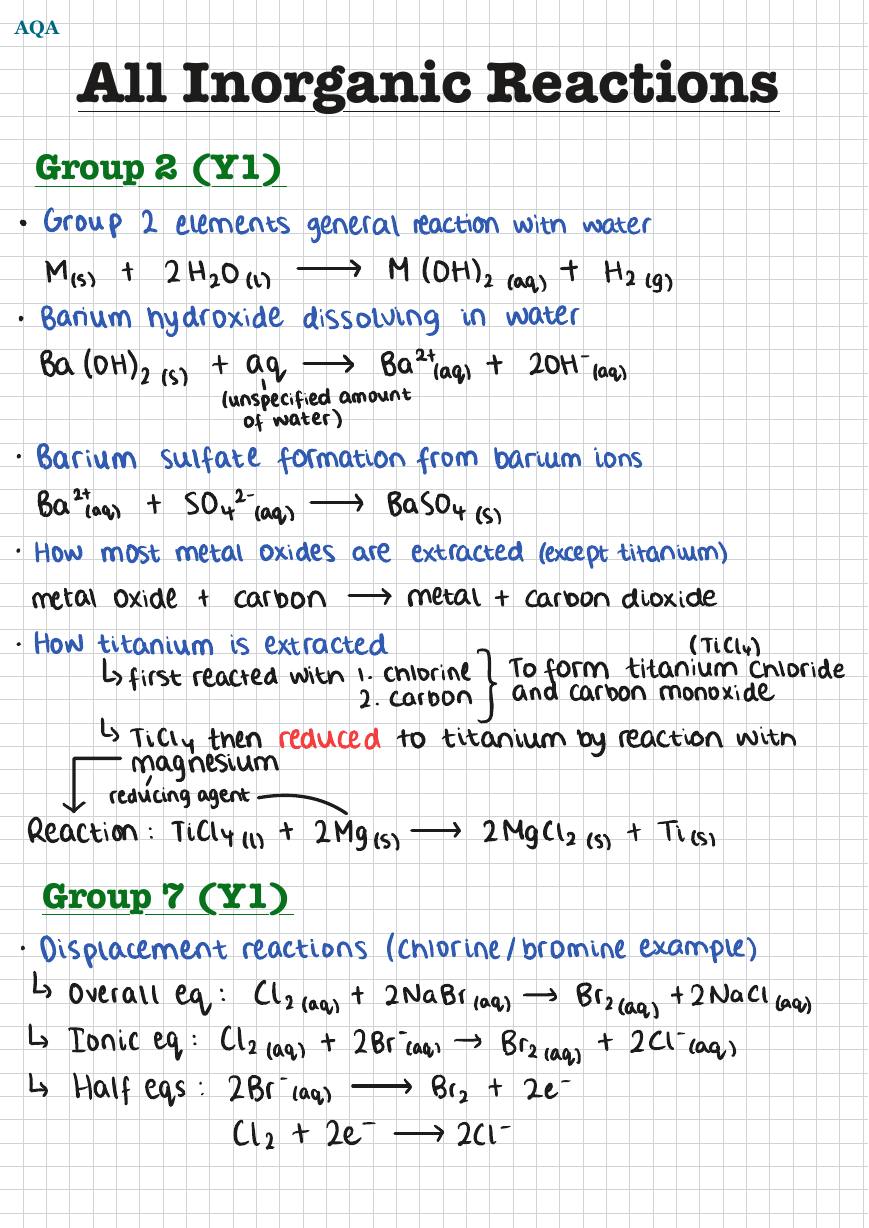
Every inorganic reaction for AQA A-Level Chemistry, organised by topic across Year 1 and Year 2 so you can revise it all in one place instead of hunting through notes.
Here’s what’s inside
Clear, colour-coded notes where every reaction comes with its balanced equation and state symbols, plus handy annotations like oxidising agents, observations and key conditions.
- Group 2: reactions with water, barium sulfate formation, extracting metals (including titanium)
- Group 7: displacement reactions, halides with concentrated sulfuric acid, chlorine with water and alkali
- Period 3: reactions of the elements with water and oxygen
- Plus transition metals and reactions of ions in aqueous solution
Pay securely with Stripe and you’ll be taken straight to a page where you can download the PDF.
More resources coming soon.
Medical School Reading List
Thinking about studying medicine, or already applying? These are some books I found very helpful for gaining a greater insight into the field. Each one has a more comprehensive summary on the back, along with its key themes and why it is useful for learning more about medicine.
MEMOIR · NEUROSURGERY
Do No Harm
Do No Harm
Henry Marsh was a consultant neurosurgeon in London, and this book collects stories from his career. Each chapter follows a patient or a type of operation, from successful surgeries to ones that went badly wrong. He is unusually honest about his mistakes, his fear and the uncertainty of operating on the brain, and he also writes about the frustrations of working in a large hospital.
Key themes
Why read it: it shows how doctors cope when decisions are high-stakes and outcomes are never guaranteed, which is great material to reflect on for interviews.
⭐ My personal pick: a book I mentioned in my personal statement and in my interviews, and one that had a very profound impact on my perception of medicine as a profession.
This Is Going to Hurt
This Is Going to Hurt
Adam Kay kept diaries while working as a junior doctor in the NHS, in obstetrics and gynaecology, before leaving medicine. The entries are very funny, but they are also open about the long shifts, the low pay, the exhaustion and the emotional weight of the job. It was later adapted into a TV series.
Key themes
Why read it: a realistic and entertaining picture of the first years after medical school, including the parts people rarely talk about.
Being Mortal
Being Mortal
Atul Gawande, a surgeon and writer, asks whether modern medicine is good at helping people through ageing, serious illness and the end of life. He looks at care homes, assisted living, hospice and palliative care, and argues that doctors should ask patients what matters most to them, not only how to extend life. He also draws on his own family’s experiences.
Key themes
Why read it: a thoughtful way to understand communication and compassion in medicine, and useful thinking for ethics questions.

Hi, welcome to Aced It Education
I’m Umer, a medical student, and I started Aced It because I remember exactly how it feels to sit in a lesson, nod along and still be completely lost. I’ve been through the exams you’re facing and came out with three A*s at A-level (Biology, Chemistry and Maths), ten grade 9s at GCSE and a UCAT score of 2370 with Band 1, so I know what examiners want and how to get there.
Our sessions are relaxed but focused. We’ll figure out where things stopped making sense, work through it together, and build the confidence to take on exams by yourself. I’ll also share the revision habits and past-paper tricks that worked for me, and if you’re thinking about medicine, ask me anything about applying or what med school is really like.
📚 Subjects
Maths, Biology and Chemistry at GCSE and A-level, plus UCAT tutoring.
🕒 Format
One hour, one-to-one, online on Zoom. Weekends 9am–3pm, Mon, Tue & Thu evenings 6–8pm.
✨ My approach
I start by finding out where you’re stuck, then we work through it together at your pace until it clicks. No rushing, no judgement, just steady progress.
🛡️ Safeguarding
I hold an Enhanced DBS check, so lessons are safe and professional for students of every age.
🏅 Results
3 A*s at A-level in Biology, Chemistry and Maths, ten grade 9s at GCSE, and 2370, Band 1 in the UCAT.
Privacy policy
Who I am
Aced It Education (“I”, “we”) provides 1-1 online tutoring. If you have any questions about this policy or your information, email acediteducationsupport@gmail.com.
What information I collect
- When you book a session: your name, email address, the session type and any notes you write, such as the subject and level. If a parent or guardian books for a student, I may also hold the student’s name and what they need help with.
- When you pay: payments are handled by Stripe and our booking tool. I never see or store your full card details.
- When you buy the PDF: your email address, which Stripe uses to send your payment receipt.
- When you email me: your email address and whatever you tell me.
How I use it
I use your information to arrange and deliver sessions, take payment, send confirmations and lesson links, reply to your messages, and keep the records I need for accounts and tax.
Why I’m allowed to
I process your information to carry out the service you have booked (contract), to meet legal duties such as keeping accounting records (legal obligation), and to run my business and answer queries (legitimate interests).
Who I share it with
I use a small number of services to run Aced It Education: Calendly for booking, Stripe for payments, Zoom for lessons, YouTube for videos, Google for email, and a web host to serve this website. This site also loads fonts from Google, which may receive your IP address. Each service has its own privacy policy, and some are based outside the UK, so your information may be transferred internationally with appropriate safeguards. I don’t sell your information.
How long I keep it
Booking and payment records are kept for as long as the law requires for accounting, which is generally around six years. Other emails and notes are kept only as long as I need them, and I’ll delete them on request where I can.
Cookies
This website doesn’t set its own cookies. Calendly, Stripe, YouTube and Google Fonts may use cookies or similar technologies when you use them, so see their policies for details.
Children
Tutoring is available to students under 18. If you’re under 18, please ask a parent or guardian to book for you, or to make sure they’re happy for you to book. I only collect the information needed to teach, and I hold an Enhanced DBS check.
Your rights
You can ask to see the information I hold about you, correct it, delete it, restrict how I use it, object to my using it, or receive a copy. Email acediteducationsupport@gmail.com and I’ll respond within one month. If you’re unhappy with how I’ve handled your information, you can complain to the Information Commissioner’s Office at ico.org.uk.
Changes
If I change this policy, I’ll update it on this page and change the date above.